On the morning of August 16th, the Friends of Georgica Pond Foundation gathered with members of the community for our 2026 Annual Meeting at The Creeks.
Progress Through Partnership
A central theme of this year’s meeting was the importance of science, community involvement, and strong partnerships in improving the health of Georgica Pond. Our Executive Director, Kim Quarty, provided an update on several important initiatives underway around the Pond, including recent conservation efforts and two major stormwater projects.
In December 2025, a major conservation milestone was achieved with the preservation of 5.5 acres along Georgica Cove. Through a partnership among the Peconic Land Trust, Friends of Georgica Pond, the Town and Village of East Hampton, and private donors, the property was acquired and permanently protected through a conservation easement purchased by the Town. The parcel now joins an existing assemblage of preserved land along the north shore of the Cove, bringing the total to nearly 20 contiguous acres. This protected landscape plays an important role in supporting water quality, biodiversity, wildlife habitat, and the scenic character of Georgica Cove.
We also shared encouraging progress on two important stormwater projects that the Foundation has helped advocate for and advance. Construction on the first project, located at the headwaters of the Pond, is scheduled to begin this October. Designed to manage stormwater from a 90% rainfall event, the project will incorporate several treatment methods, including bioswales, Jellyfish filters, a below-grade stormwater treatment system, and revegetation. Together, these measures will help slow, absorb, and filter stormwater before it reaches the Pond.
A second project, planned for next year at Georgica Cove, will provide an “end-of-pipe” treatment designed to improve stormwater quality before it enters the Pond. Stormwater from the Cove Hollow pipe will be directed through a constructed wetland, where natural processes will help filter pollutants before the water reaches the Cove. The project will also incorporate Phragmites abatement.
We are grateful to the Village of East Hampton, East Hampton Town Trustees, East Hampton Town Board, the Town’s Natural Resources Department, the New York State Department of Environmental Conservation (NYSDEC), the New York State Department of Transportation (NYSDOT), Peconic Land Trust, and our many other partners whose cooperation and commitment are essential to moving these projects forward and protecting the Pond.
Reducing Pollution at Its Source
Our guest speakers highlighted practical ways property owners can help protect the Pond and its surrounding watershed.
Edwina von Gal of the Perfect Earth Project discussed the value of ecological landscaping, including native plantings and vegetative buffers, which can reduce runoff and help prevent pollutants from reaching our waterways. Tom Varley of the Center for Clean Water Technology addressed the importance of upgrading conventional septic systems to innovative/advanced (I/A) systems, which reduce the amount of nitrogen entering groundwater and, ultimately, our surface waters.
For individual property owners, upgrading an outdated septic system is the single most impactful action you can take to reduce nitrogen loading and help improve the water quality of Georgica Pond.
The science is clear: excessive nitrogen promotes algal blooms in the Pond, and wastewater is the largest source of nitrogen entering Georgica Pond. Reducing nitrogen at its source is therefore critical to the Pond’s continued recovery.
There is already significant momentum. To date, 56 nitrogen-removing I/A septic systems have been installed in the Georgica Pond watershed, with another 29 property owners exploring upgrades. We strongly encourage every property owner with an outdated system to consider joining this effort.
The State of Georgica Pond
Dr. Christopher Gobler, the Foundation’s Science Advisor, presented his annual State of Georgica Pond report, providing an important scientific perspective on both the progress that has been made and the challenges that remain.
There was encouraging news. Blue-green algae levels in 2026 were the lowest recorded in the 14 years of data presented, continuing a dramatic improvement from conditions observed before implementation of the FOGP management plan.
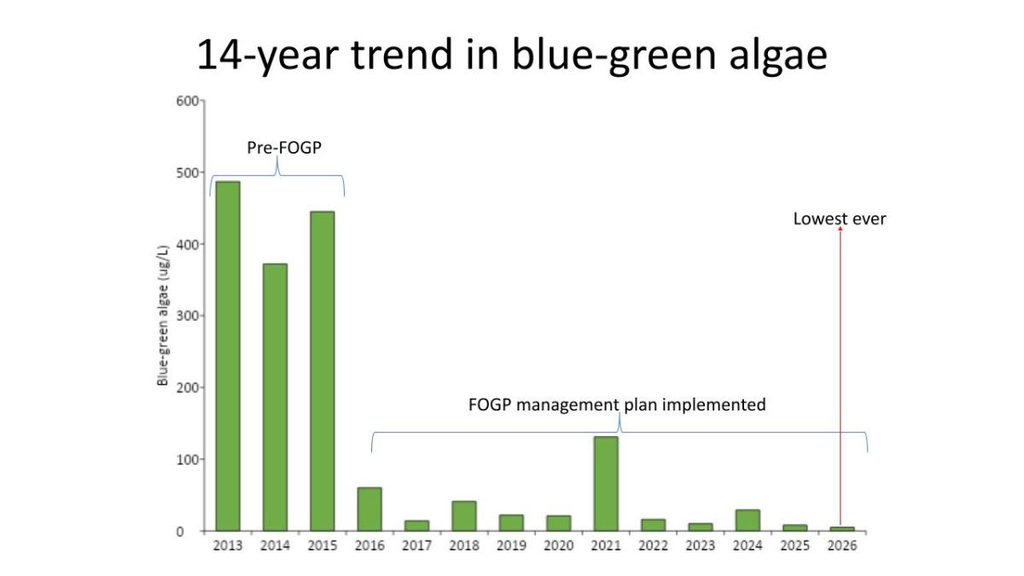
The long-running aquatic weed harvesting program has also played an important role. From 2016 through 2025, nearly 340,000 pounds of aquatic vegetation were removed from the Pond, along with more than 1,000 pounds of nitrogen.
At the same time, the science makes clear that our work is not finished. Excessive nitrogen continues to promote algal blooms, and wastewater remains the largest source of nitrogen entering Georgica Pond. Dr. Gobler emphasized that accelerating the removal of nitrogen from wastewater will be central to the Pond’s continued recovery. Legacy agricultural nitrogen moving through groundwater also remains a challenge that requires remediation.
The presentation also addressed emerging concerns surrounding PFAS in the watershed. Research has identified pathways by which PFAS can reach Georgica Pond, while new remediation approaches—including a planned permeable reactive barrier at Talmage Creek—are being advanced to remove PFAS and nitrogen from groundwater. There was positive news on another front as well: long-term research shows that oysters are surviving, growing, and reproducing in Georgica Pond, suggesting they may have an important role to play in the Pond’s long-term ecological restoration.
What You Can Do
The progress we are seeing gives us reason for optimism, but it also reinforces the need to accelerate our collective efforts.
If there is one action we hope property owners will take, it is this: upgrade your septic system. Reducing the nitrogen entering our groundwater and the Pond from wastewater is essential to achieving lasting improvements in water quality.
Property owners can also make an important difference by adopting sustainable landscaping practices, using organic or low-nitrogen fertilizer, establishing native vegetative buffers along the Pond, and staying engaged with local policies affecting the health of the watershed.
And, of course, continued community support makes the Foundation’s work possible. Your contributions allow FOGP to pursue its mission of preserving the Georgica Pond ecosystem for future generations through science-based, watershed-wide policy and restoration.
We extend our sincere thanks to our speakers, partners, Board of Directors, supporters, and everyone who joined us for this year’s Annual Meeting. The improvements we are seeing demonstrate what sustained science, collaboration, and community commitment can accomplish.
There is much to celebrate, and much more to do. Together, we can build on this progress and help ensure a healthy and resilient Georgica Pond for generations to come.